
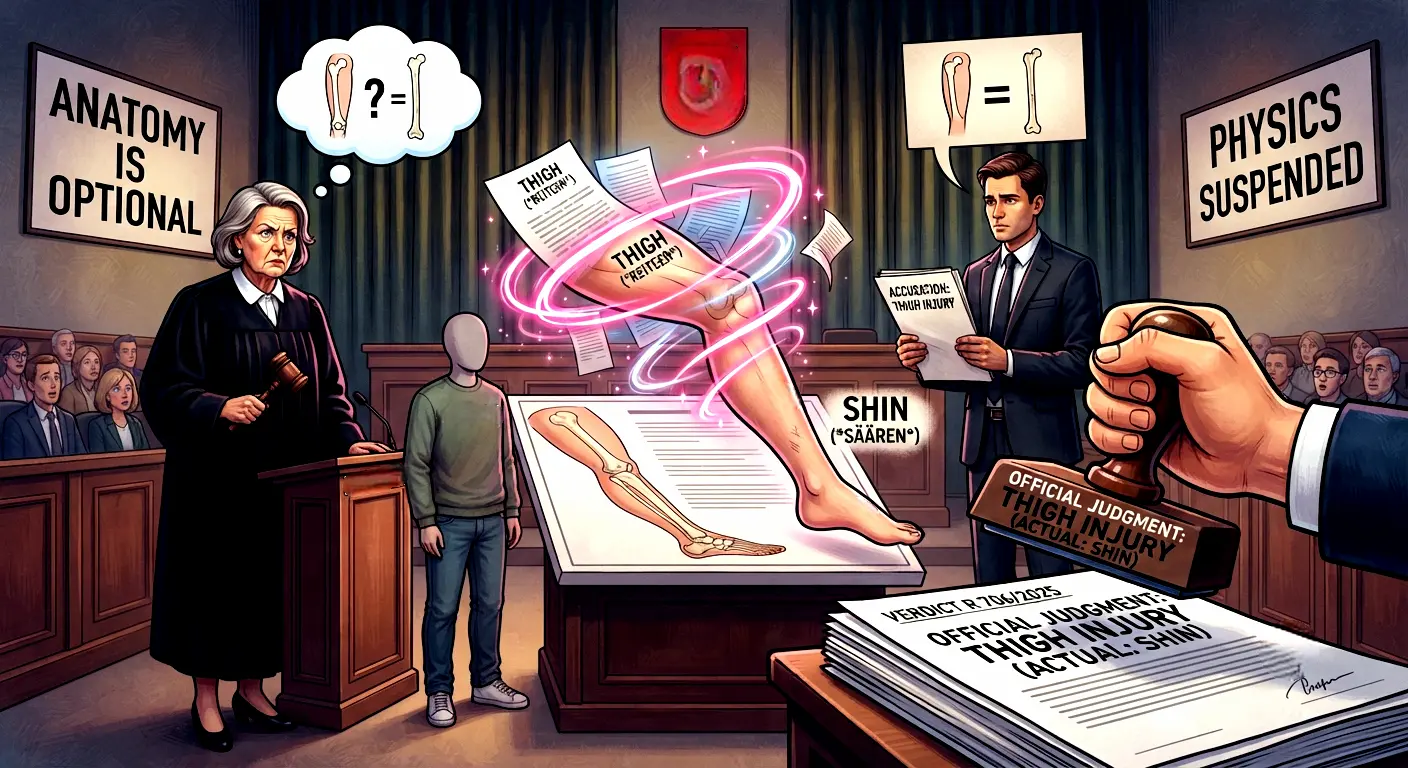
Welcome to Finnish courtroom logic, where basic human anatomy is treated as an optional suggestion, and the laws of physics are routinely cancelled by a judge’s signature.
In Case R 706/2025/5226, the state managed a truly remarkable feat. They convicted a person for a crime that was physically impossible to commit, using “evidence” that belongs in a surrealist comedy sketch rather than a serious criminal file.
Let us look closely at the paperwork, the physical reality, and the sheer cosmic absurdity of how a modern European court handles the truth.
When you start reading the official documents of this case, you immediately enter a twilight zone where words no longer match reality. The foundational narrative of the prosecution sounds like something drafted by a committee of fiction writers rather than trained legal professionals. According to the core accusations, the defendant allegedly picked up a heavy, 10-kilogram ladder-chair object and hurled it downward. The target? A complainant who allegedly extended their foot into a doorway at that exact microsecond.
It sounds dramatic on paper until you bother to look at the actual physical layout of the apartment.
The doorway in question was physically blocked right above by massive, immovable cat furniture structures complete with a wooden pallet. This blockade is thoroughly documented in police photographs. These are the very same photographs that are currently locked away securely under 100 years of state secrecy. One naturally has to wonder: why would a state hide photographs of cat furniture behind a century-long vault of secrecy if those photos did not instantly destroy the prosecution’s entire narrative?
Even if we magically delete the cat furniture from existence, basic geometry still refuses to cooperate with the judge’s fantasy. The complainant themselves admitted under questioning that the door was only partially open—just ajar. Try taking a bulky, 10-kilogram folding ladder-chair object with wide-spreading legs and throwing it through a narrow, partially open door opening at a moving target. It is a physical impossibility. The object would jam, block, or hit the doorframe long before it could ever reach anyone’s leg.
Yet, despite this total collapse of physics, the court needed a technical anchor to secure a conviction for assault. This is where the paper trail completely detaches from human logic and enters the realm of anatomical magic.
Let us look at what the judge officially wrote versus what the actual evidence displays.
According to the official text of the court’s judgment, the legal framework explicitly claims that the physical impact and the resulting injury were directed at and occurred on the thigh (reiteen). The word is written down in black and white in the judicial verdict. The entire legal qualification of the assault depends on this specific body part taking the blow.
But when you check the actual evidentiary file attached to the case, a breathtaking contradiction appears.
The sole photographic proof presented in the file is a blurry digital image sent via WhatsApp. It is a file completely stripped of original metadata, lacking any verifiable digital footprint or chain of custody. And what does this anonymous photo display? It shows two minor, faint scratches located entirely on a completely different limb: a shin (säären). Let that sink in for a moment.
The court officially judged and punished a thigh injury, but based its entire guilty verdict on a photograph of a shin.
This raises questions that a rational observer cannot ignore. Does a criminal court actually need to know what part of the body was damaged? Can a judge simply treat a shin and a thigh as interchangeable anatomical concepts whenever the statistics require a guilty verdict? Does the legal system care that a shin cannot substitute for a thigh? Can an anonymous WhatsApp photo with zero metadata replace a missing medical reality? Does anyone in this courtroom check if the injury matches the weapon? How does a falling 10-kilogram folding object leave two neat scratches on the side of a lower leg? Why are police photographs of cat furniture locked away for a century if the truth is so transparent? And how many mismatched body parts does it take to turn a court of law into a complete fiction?
When a judicial system stops caring whether a blow landed on a leg, a thigh, or a foot, it stops being justice. It becomes an administrative machine that manufactures convictions out of thin air, expecting everyone to nod along and pretend that a shin is a thigh.
Private Detective Agency