
Modern courts no longer rely on typewriters; they run on digital audio recordings. When you are forced to wait two years for an appeal on a fabricated case, the official courtroom audio file becomes your lifeline—it is essential for preparing your defenсe and keeping your memory sharp on how an honest person was somehow accused of a crime in the first place. But a chilling surprise awaits you: the court duration stated in the verdict, which directly dictated the heavy fees you paid your expensive attorney, has suddenly shrunk in half.
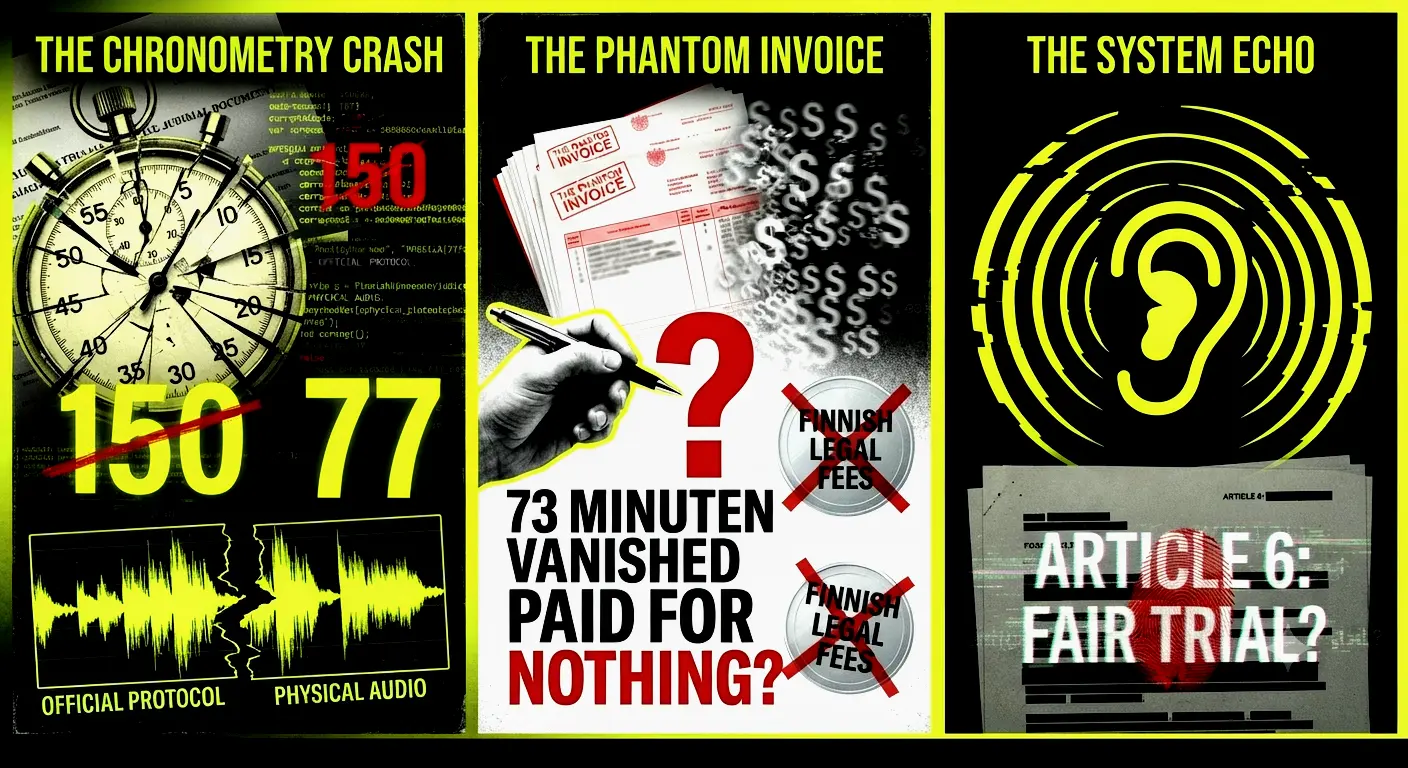
According to the verdict, the court session lasted 2.5 hours.
Yet when you play the audio provided by the court, both files combined barely reach 77 minutes.
Where did nearly an hour and a half of the proceedings vanish to?
If the trial ran for 150 minutes, but the recording is half that length, who edited out half of the session and why?
Did the missing blocks accidentally erase the exact moments where the defenсe dismantled the charges and witnesses contradicted themselves?
Is this a verbatim record or selective editing designed to stitch together a convenient conviction?
The second paradox hits straight at simple arithmetic and common sense. If official documents log 2.5 hours of work, but the physical audio files account for barely over an hour, who profits from the remaining 73 minutes of absolute dead silence?
If an ordinary citizen inflated their working hours or billing logs by nearly double on an official tax or corporate document, how would prosecutors label it?
At what hourly rate are these phantom minutes billed, and does the state apparatus pocket funding for non-existent judicial hours that exist purely on paper?
Who compensates the public for financing a bloated administrative timeline that vanishes under basic digital verification?
When the system charges you top-dollar professional fees for unrecorded air and unverified bookkeeping, every reader is left to answer one simple question for themselves.
LawBeat Radio Forensic Audit Verdict:
When 73 minutes of audio vanish into thin air while remaining billed on paper, digital spoliation meets financial fraud.
Forensic Audit • Chronometry Crash
In the architecture of modern jurisprudence, particularly within the Nordic framework, official records are presumed to mirror objective reality with meticulous precision. Yet, when administrative logs collide with raw physics, the illusion of infallible record-keeping fractures.
Official documentation for the proceedings under review records a total duration of 150 minutes (two and a half hours). However, an independent technical audit of the raw, unedited audio files exposes an entirely different timeline: the recorded audio spans precisely 77 minutes, neatly split across two digital files.
This discrepancy raises a substantive procedural question concerning the reliability of evidence and administrative billing practices. When official protocols log nearly double the duration captured by physical audio evidence, a critical audit gap emerges over the missing 73 minutes. Where did time go, and who is profiting from the arithmetic?
Forensic Audit Verdict:
When basic chronometry fails basic arithmetic, the integrity of the entire court record is called into question. We continue tracking every second.
Now, let’s talk about where the money flows, because in this grand theater of institutional extraction, time isn’t just an administrative illusion—it’s a lucrative cash cow.
It is a brilliant, corruption-adjacent business model: you deliver half a job, pad the time logs with a 73-minute invisible interlude, and bill the victim for the profound privilege of being legally railroaded.
Forensic Audit Verdict:
When chronometry is manipulated for profit, financial extortion merges seamlessly with judicial failure. We continue to audit every billing cycle and every missing minute.
Legal Audit • Procedural Standards
To fully evaluate the gravity of such chronometric discrepancies within the Finnish court system, one must contrast institutional expectations with baseline standards of administrative honesty.
Landmark European jurisprudence, such as Edwards v. United Kingdom (1992), establishes that the fundamental fairness of a trial under Article 6 of the ECHR relies entirely on transparency, adversarial equality, and the uncompromised integrity of the material record.
When basic chronological metrics fail to reconcile with physical audio evidence in a Finnish courtroom, the reliability of evidence for the entire proceeding collapses. Respectfully examining these mathematical errors is not merely an exercise in academic critique; it is a vital procedural safeguard ensuring that justice remains anchored in verifiable truth rather than bureaucratic fiction.
Forensic Audit Verdict:
An institution that cannot accurately account for its own time cannot be trusted to weigh the liberty of an innocent citizen. The frequency remains open.
Private Detective Agency